

Zizobet
5.0Welcome Bonus
550% up to £3,800 across 4 deposits + 50 Free Spins
- High Bonus System
- Dual-wallet system
- 24/7 Chat Support
JeffBet Casino runs under ProgressPlay Limited UKGC account 39335. Compare five active same-account casino brands and the 2025 sanction context.
Zizobet
5.0Welcome Bonus
550% up to £3,800 across 4 deposits + 50 Free Spins

Cosmobet
5.0Welcome Bonus
750% + Up to 7000€ 1000 FREESPINS +25% Cashback

Wildies
4.9Welcome Bonus
Welcome Pack 400% up to £3200 + 150 FS

WinBeast
4.9Welcome Bonus
WELCOME PACK £5000 + 500 Free Spins

SlotoSport
4.9Welcome Bonus
Welcome Package £12000 + 777 FS

Velobet
4.8Welcome Bonus
GET UP TO 330% BONUS + 300 FREE SPINS!

7Gear
4.8Welcome Bonus
Welcome Reward Up To £5000 + 500 FS

Spin Polo
4.8Welcome Bonus
Welcome Pack 777% up to £ 7777 + 385 FS

Lilu Casino
4.7Welcome Bonus
Welcome Package 325% Up to £3750 + 500 FS

Truststake
4.7Welcome Bonus
100% Up To 1500 EUR + 100 FS

CleanWins
4.7Welcome Bonus
Welcome Bonus 200% Up To £2000 + 200 FS

Rolletto
4.6Welcome Bonus
725% Up to 7000€+ 200 FREESPINS + 20% Cashback

Betmac
4.6Welcome Bonus
100% Up To 525 EUR + 100 FS

AmunBet
4.6Welcome Bonus
Welcome Package 450% To £3000 + 450 FS

Smash Casino
4.5Welcome Bonus
600% Up To £10 000 + 25% Cashback

Daytona Spin
4.5Welcome Bonus
Welcome Pack 255% up to £4500 + 255 FS
The current JeffBet Casino casino UK brand sits under ProgressPlay Limited, using UKGC account number 39335. This guide profiles five active same-account brands and explains the 2025 sanction context.
| Brand | Our Rating | Welcome Bonus | Payout Speed (E-Wallets) | Top Feature |
| Monster Casino | 5.8/10 | Welcome package advertised up to GBP 1,000 plus spins | Operator target 1-5 days after processing | Large game lobby and broad live-casino mix |
| Mobile Wins | 6.0/10 | Casino bonus up to GBP 200 or sports free-bet route | Operator FAQ pattern says processing within 3 business days | Mobile-first layout with casino and sportsbook |
| SpinzWin | 5.9/10 | Up to GBP 1,000 plus 100 free spins on public pages | Operator target 1-5 days after processing | Slots-heavy ProgressPlay skin |
| PlaceBet | 6.1/10 | Sports and casino promotions vary by product page | Operator target 1-5 days after processing | Cleaner sports-casino wrapper |
| Mobile Slots | 6.3/10 | Up to GBP 200 bonus on the live homepage | Operator target 1-5 days after processing | Simple slot-led mobile casino |
Ratings reflect licence, terms, enforcement data and reviews; verify offers.
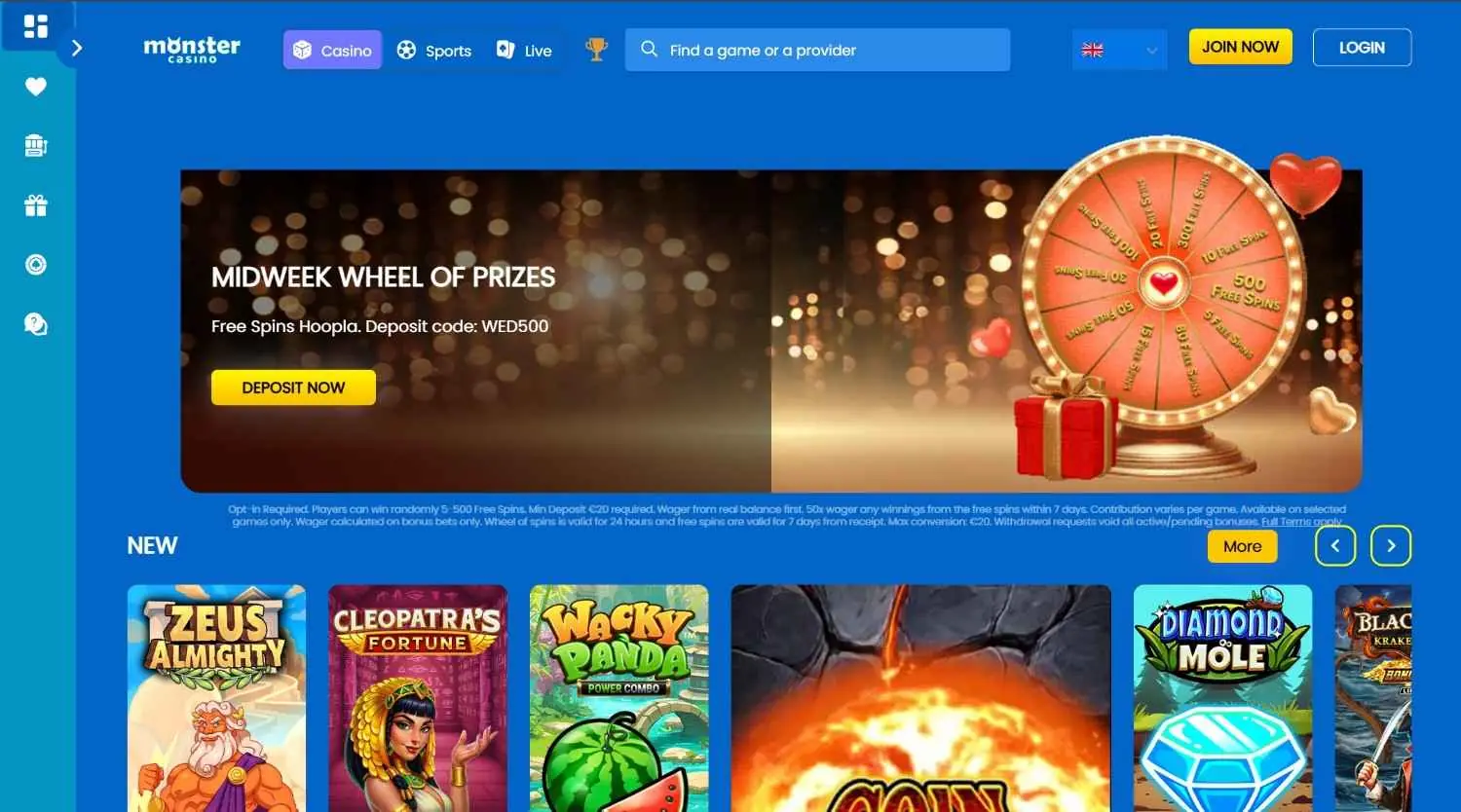
Monster Casino is the loudest of the five same-account brands in this guide. The live homepage loaded in our June 2026 check, and the UKGC domain table lists www.monstercasino.com as a white-label domain under ProgressPlay Limited account 39335. That puts it in the same licence trail as JeffBet, even though the brand design, bonus wrapper, and casino-first presentation feel separate from the sportsbook-led JeffBet homepage.
For a same-market contrast outside ProgressPlay, the Zizobet Casino review shows how a newer UK-facing brand frames bonus value and safety evidence.
The core appeal is scale. Casino Guru's MonsterCasino page, checked June 2026, lists a Below average Safety Index of 5.9/10, 90 game providers, 27 payment methods, 8 direct complaints and 5 related-casino complaints. Those numbers explain the risk profile better than a generic Monster Casino sister sites list would. The provider panel includes Play'n GO, NetEnt, Nolimit City, Blueprint, Evolution, Pragmatic Play, Red Tiger, Big Time Gaming and Playtech. Casino Guru also records monthly withdrawal limits of EUR 6,000.
Monster is a genuine JeffBet Casino sister site, not a separate recommendation pasted in to fill space. It uses the same ProgressPlay platform pattern, similar bonus language, overlapping payment rails and the same UKGC account number. Compared with JeffBet, Monster leans harder into slot variety and casino visuals, while JeffBet carries a stronger sports-and-casino identity. The main drawback is sentiment: Trustpilot showed 1.6/5 from 200 reviews in June 2026, with 88% one-star reviews and repeated withdrawal, verification and bonus-friction complaints. That is why Monster can be useful for game depth, but not the best JeffBet Casino sister site for players who mainly care about smoother payouts.
| Metric | Details |
| Site Identity | Big-lobby ProgressPlay casino with sportsbook elements |
| What Sets It Apart | The widest provider footprint in this five-brand comparison |
| Game Selection | 90 providers listed by Casino Guru, with Evolution, NetEnt, Pragmatic Play and Playtech |
| Best Bonus Feature | Large headline welcome package with free spins on public review pages |
| Drawback | Low player sentiment and low monthly withdrawal limits in Casino Guru data |
| Ideal Player | Slot players who value library breadth more than brand polish |
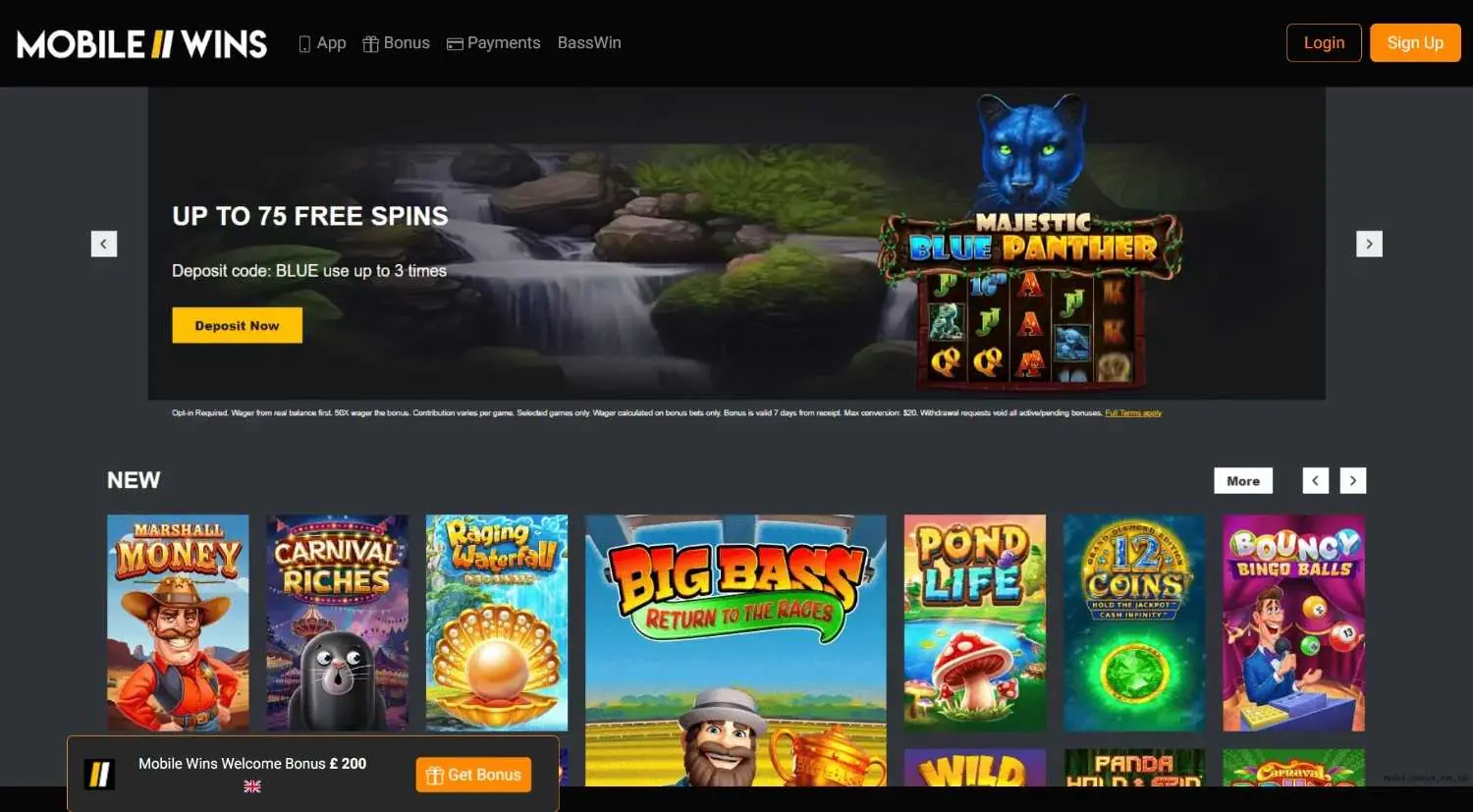
Mobile Wins is the strongest mobile-first option among these same-account brands. The homepage loaded cleanly during the live check, the brand is listed on the UKGC domain table as www.mobilewins.co.uk under ProgressPlay Limited, and Trustpilot's company description says it offers more than 1,000 games across slots, live games, table games and sports betting. That makes it a closer match to JeffBet's one-wallet approach than a pure slots site.
Players comparing mobile-first lobbies can use Winomania sister sites as a separate UKGC network reference before choosing a ProgressPlay skin.
Mobile Wins sister sites coverage often treats the brand as an old-school mobile casino, but the live Trustpilot page in June 2026 shows why the article needs a cautious tone. Trustpilot displayed 1.4/5 from 109 reviews, with 89% one-star reviews and several complaints about delayed withdrawals, verification and bonus handling. Casino Guru's Mobile Wins page, checked through its indexed review text in June 2026, gave a 6.9/10 Above average Safety Index, 0 direct complaints and 5 related-casino complaints worth 14 black points. That is a better specialist signal than the Trustpilot mood, but the two sources still diverge sharply.
Mobile Wins works as a sites like JeffBet Casino candidate for players who want the same operator trail with a lighter mobile interface. Payment support is similar across ProgressPlay pages: Visa, Mastercard, Skrill and Neteller appear on JeffBet's FAQ, while Casino Guru and AskGamblers list wider wallet sets. The best use case is small-stake testing, immediate KYC preparation and modest bonus expectations. Mobile Wins is a genuine JeffBet Casino alternative when mobile access matters.
| Metric | Details |
| Site Identity | Mobile-led casino and sportsbook under the same UKGC account |
| What Sets It Apart | Lighter interface than Monster Casino and JeffBet |
| Game Selection | Public profile describes 1,000+ games, with slots, live games and sports betting |
| Best Bonus Feature | Casino bonus up to GBP 200 or a sportsbook free-bet route |
| Drawback | Trustpilot sentiment is weak despite a stronger Casino Guru score |
| Ideal Player | Mobile-first players who want a same-operator comparison |

SpinzWin is a slots-first member of the ProgressPlay portfolio and one of the clearer sister sites of JeffBet Casino. The live homepage loaded in June 2026 and advertised an online casino UK offer of GBP 1,000 plus 100 free spins. The UKGC domain table lists www.spinzwin.com as a white-label domain under account 39335, which ties the brand to the same licence account as JeffBet and the other ProgressPlay casinos in this guide.
Casino Guru's SpinzWin Casino review, checked June 2026, showed a 6.0/10 Below average Safety Index, no user feedback score, 0 reviews and an explicit warning that the terms were considered unfair. The same review states that related-casino data lowered the Safety Index, so this is not a clean standalone score. It is useful because it captures the network effect: if ProgressPlay terms, payment checks and complaint handling are shared, a problem across the wider group can affect how the brand is assessed.
SpinzWin sister sites are useful to compare with JeffBet because the product split is clearer. JeffBet pushes casino, live casino, bingo and sports from a single hub; SpinzWin presents itself as a casino-first brand with a bigger headline bonus. The trade-off is that large welcome offers can carry expiry rules, game contribution limits, max conversion caps and e-wallet exclusions. Free-spin summaries can mention SpinzWin, but the live offer should be checked at the cashier before play because no-deposit availability changes faster than the licence data.
| Metric | Details |
| Site Identity | Slot-led ProgressPlay casino with a large headline welcome offer |
| What Sets It Apart | Stronger casino identity than JeffBet's sportsbook-casino blend |
| Game Selection | Broad ProgressPlay lobby with slots, table games and live dealer content |
| Best Bonus Feature | Public homepage offer of up to GBP 1,000 plus 100 free spins |
| Drawback | Casino Guru marks the Safety Index below average and flags unfair terms |
| Ideal Player | Bonus-aware slots players who read terms before depositing |
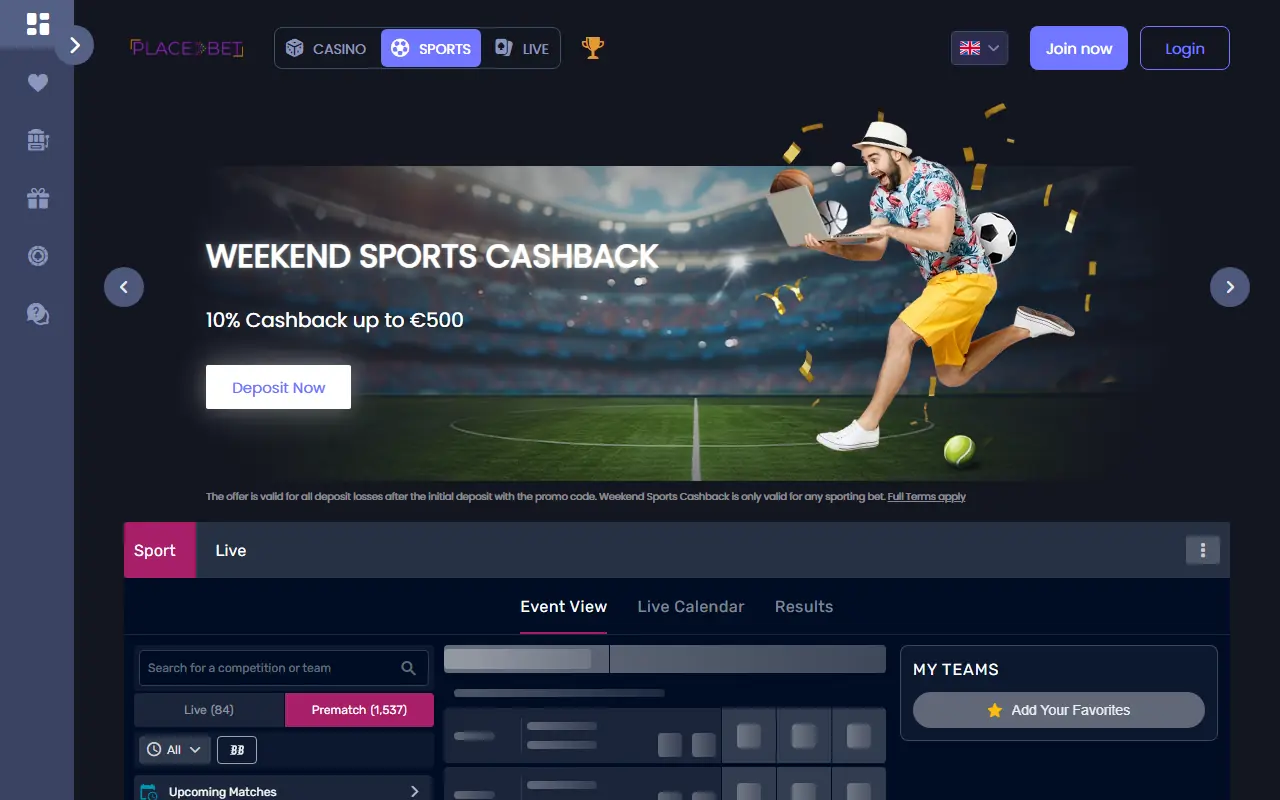
PlaceBet is the cleanest sports-casino wrapper in this ProgressPlay group. The live homepage returned a ProgressPlay configuration payload in June 2026 with displayName "PlaceBet", and the UKGC public register lists placebet.co.uk as an active ProgressPlay Limited domain. That makes it one of the most direct sites like JeffBet Casino for readers who use casino games and sports betting from one balance.
Casino Guru's PlaceBet Casino review was available through its live international page in June 2026 and showed a 6.3/10 Below average Safety Index, 0 user reviews and low complaint value relative to size. The review also stated that Casino Guru considered the terms unfair. PlaceBet looks cleaner than many ProgressPlay brands, but the legal and bonus framework still deserves attention. A polished front end does not remove the need to read wagering, max bet, withdrawal and verification rules.
PlaceBet sister sites overlap with JeffBet on the same UKGC account number and many of the same operational rails. Compared with Monster Casino, PlaceBet feels less cluttered. Compared with Mobile Wins, it puts more emphasis on sportsbook structure. Compared with JeffBet, it is an alternative inside the same licence account rather than a change of operator. It is a good JeffBet Casino alternative for a player who likes sports-led navigation, but it should not be treated as an escape from ProgressPlay's 2025 AML and social-responsibility enforcement history.
| Metric | Details |
| Site Identity | Sports-casino ProgressPlay brand with a cleaner front end |
| What Sets It Apart | Closest product shape to JeffBet's sportsbook-plus-casino layout |
| Game Selection | Shared ProgressPlay casino lobby with live dealer and slot content |
| Best Bonus Feature | Sports and casino promotions available through the live product |
| Drawback | Casino Guru score is below average and terms are flagged as unfair |
| Ideal Player | Sports bettors who also want a casino tab under the same account style |
Mobile Slots is the simplest casino-first option among these same-account brands. The live homepage loaded in June 2026 and advertised "Mobile Slots & Casino Games" with an up to GBP 200 bonus. The UKGC public register lists www.mobileslots.com as an active domain under ProgressPlay Limited account 39335, so the licence trail is clear.
Mobile Slots sister sites searches can be messy because Casino Guru has a "Slots Mobile Casino" entry that is marked closed and may not map neatly to the live www.mobileslots.com UKGC domain. For this article, the primary evidence is the live homepage plus the UKGC domain table, not a mismatched closed-brand page. The product itself is straightforward: slots and casino games first, mobile usability second, and fewer sportsbook signals than JeffBet or PlaceBet.
For readers comparing JeffBet Casino similar sites, Mobile Slots is the best same-operator pick when the goal is a plainer casino lobby. It is not automatically safer than JeffBet, because the same account number and ProgressPlay controls apply. It does separate the casino experience from the heavier sports presentation. That helps if your JeffBet Casino review concern is usability rather than operator risk.
| Metric | Details |
| Site Identity | Simple mobile casino brand on the ProgressPlay account |
| What Sets It Apart | Less sportsbook clutter than JeffBet or PlaceBet |
| Game Selection | Slot-led lobby with casino games on mobile and desktop |
| Best Bonus Feature | Public homepage bonus up to GBP 200 |
| Drawback | Limited independent review coverage for the exact live UKGC domain |
| Ideal Player | Players who want the least complicated same-operator casino option |
We checked the UKGC public register for ProgressPlay Limited, fetched each profiled homepage, reviewed JeffBet's own casino and FAQ pages, compared Casino Guru Safety Index data, and checked Trustpilot and AskGamblers player signals in June 2026. We also assessed cashier claims, bonus terms, game-provider depth and complaint patterns. Our testing uses representative deposits and withdrawal-timing checks across the market, but for this article the strongest evidence is live register and public-page verification rather than a claim that every ProgressPlay cashier was retested on the same day.
For bonus-led comparison, the BubblesBet review is useful because it separates headline offer size from payout and verification risk.
The key bonus lesson across this network is that the headline number is less important than the wagering rule and conversion cap. JeffBet's AskGamblers listing, checked June 2026, showed 100% up to GBP 100 plus 50 bonus spins, with 10x wagering on bonus money within 30 days, 10x wagering on free-spin winnings within 7 days, a GBP 500 free-spin win cap, Skrill and Neteller exclusions, and a rule that withdrawal requests void active or pending bonuses.
If the main draw is spins rather than matched cash, compare the terms against our free spins casinos UK page and avoid assuming a bigger spin count is better.
A worked example helps. If a player deposits GBP 100 and receives a GBP 100 bonus, the bonus balance creates GBP 1,000 of wagering at 10x. If spins create GBP 40 of bonus winnings, those winnings create GBP 400 of wagering at 10x. At GBP 0.50 per spin, the first example is 2,000 spins before any game weighting adjustment. UKGC LCCP SR Code 5.1.1 caps wagering requirements at 10x where it applies from 19 January 2026, which makes older 35x summaries less relevant for UK-facing offers. No-deposit promotions should be treated carefully: eligibility, expiry and max cash-out terms decide the real value.
JeffBet is broader than most of its siblings. Its own casino page, checked June 2026, says JeffBet has 2,500+ slot games, 20+ studios, 100+ live tables and game shows, 24/7 support, mobile-friendly browser play and 1-5 day winnings receipt for most customers. That makes JeffBet a stronger all-rounder than Mobile Slots, a cleaner sportsbook-casino option than Monster Casino, and a more recognisable brand than several smaller ProgressPlay skins.
A sportsbook-casino reader who wants another operator lens can compare the Betnuvo review before staying inside the ProgressPlay account.
The weakness is trust. Casino Guru gives JeffBet a 7.0/10 Above average Safety Index, while Trustpilot shows 1.3/5 from 257 reviews with 86% one-star ratings. AskGamblers shows 6/10 from one player review and 1 unresolved complaint worth USD 60. Those signals make the comparison more about risk control than chasing the biggest welcome package. JeffBet Casino casino sister casinos share the same account, so a player choosing between them should compare interface, bonus fit and payment evidence rather than assume a different brand means a different back office. ProgressPlay Limited casinos have remained active, but the network is not reputation-clean after the 2025 UKGC action. Other ProgressPlay Limited casinos on the UKGC domain table show the same need for brand-level checks.
| Payment Method | Min Deposit | Max Deposit | Withdrawal Time | Fees |
| Visa | GBP 10 typical network floor | Brand cashier limit applies | Processing within 3 business days, bank receipt up to 7 business days | JeffBet says no transaction fees |
| Mastercard | GBP 10 typical network floor | Brand cashier limit applies | Processing within 3 business days, bank receipt up to 7 business days | JeffBet says no transaction fees |
| Skrill | GBP 10-20 depending on brand | Brand cashier limit applies | Often faster after approval, but bonus exclusions apply | Check cashier before opting in |
| Neteller | GBP 10-20 depending on brand | Brand cashier limit applies | Often faster after approval, but bonus exclusions apply | Check cashier before opting in |
| PayPal | Listed by AskGamblers and Casino Guru for JeffBet | Brand cashier limit applies | Usually quicker after approval | Availability can vary by brand |
| Bank Wire | Minimum withdrawal GBP 50 on JeffBet FAQ | Bank limit applies | Up to 7 business days after processing | No JeffBet transaction fee stated |
For UK players, debit card and bank transfer are the cleanest evidence-led choices because JeffBet's own FAQ names Visa, Mastercard, Skrill and Neteller, while its withdrawal FAQ gives the 3 business day processing rule and GBP 50 wire minimum. E-wallets can be convenient, but bonus exclusions matter. If a player wants a faster-payout comparison, the better move is to complete verification before wagering and avoid bonus funds until the first withdrawal has cleared.
Phone-bill deposit users should compare any ProgressPlay cashier option with dedicated Pay by Phone casinos coverage, because payment limits can differ from debit-card deposits.
| Site | Top 5 Providers | Approx. Game Count | Live Dealer Available |
| JeffBet Casino | Pragmatic Play, NetEnt, Play'n GO, Evolution, Playtech | 2,500+ slots, 100+ live tables on JeffBet page | Yes |
| Monster Casino | Play'n GO, NetEnt, Nolimit City, Blueprint, Evolution | 90 providers on Casino Guru | Yes |
| Mobile Wins | NetEnt, Pragmatic Play, Evolution, Playtech, Play'n GO | Trustpilot company text says 1,000+ games | Yes |
| SpinzWin | Pragmatic Play, NetEnt, Evolution, Playtech, Blueprint | Homepage advertises 500+ online slots | Yes |
| PlaceBet | ProgressPlay shared lobby providers | Shared casino lobby, count not separately itemised | Yes |
| Mobile Slots | ProgressPlay shared lobby providers | Slot-led lobby, count not separately itemised | Yes |
Provider overlap is high because ProgressPlay supplies the platform. JeffBet's own page names Pragmatic Play, NetEnt, Scientific Games, Play'n GO, Wazdan, Eyecon, Spinomenal, Evolution and Playtech. Monster has the deepest third-party provider evidence from Casino Guru. Mobile Slots is the plainest JeffBet Casino alternative for players who want the same provider pool without the sportsbook framing.
Table-game players should also compare live and RNG baccarat depth against our baccarat casinos guide before choosing a slots-heavy skin. The broader provider mix still matters: Evolution and Playtech dominate live tables, while Pragmatic Play, NetEnt and Play'n GO shape many slot sessions across the same shared platform.
For a separate game-library comparison, the Kings Chip Casino review gives a different provider mix from the ProgressPlay lobby.
| Site | Licence Body | UKGC Account No. | Self-Exclusion Available | RNG Testing |
| JeffBet Casino | UKGC and MGA | UKGC account number 39335 | UKGC remote-casino self-exclusion options | Supplier and platform testing stated |
| Monster Casino | UKGC and MGA | UKGC account number 39335 | UKGC self-exclusion options | Supplier-certified games |
| Mobile Wins | UKGC and MGA | UKGC account number 39335 | UKGC self-exclusion options | Supplier-certified games |
| SpinzWin | UKGC and MGA | UKGC account number 39335 | UKGC self-exclusion options | Supplier-certified games |
| PlaceBet | UKGC and MGA | UKGC account number 39335 | UKGC self-exclusion options | Supplier-certified games |
| Mobile Slots | UKGC and MGA | UKGC account number 39335 | UKGC self-exclusion options | Supplier-certified games |
The UKGC register lists ProgressPlay Limited account number 39335, remote casino active from 1 November 2014, remote general betting active from 17 December 2018, and remote bingo active from 23 August 2024. It also lists 191 domain names. Old www.jeffbet.com is inactive while jeffbet.net is white label, so this article treats JeffBet as live on the current domain rather than closed.
For readers checking account numbers and licence wording, the gambling licences explained guide explains how operator records differ from brand names.
The 2025 regulatory action is material. On 9 May 2025 the UKGC imposed a warning, an additional licence condition requiring a third-party audit within 6 months, and a GBP 1,000,000 financial penalty on ProgressPlay Limited. The failures were AML controls, AML measures for foreign-jurisdiction operators and Social Responsibility Code Provision 3.4.3 customer interaction. The practical implication for UK players is stricter source-of-funds checks and more evidence requests around withdrawals. For disputes, start with the operator complaint process, then use ADR where eligible and the Gambling Commission public guidance for licence checks. For support around gambling harm, use GamCare counselling resources and BeGambleAware.
The dominant complaint theme is withdrawal friction. Trustpilot's JeffBet page showed 1.3/5 from 257 reviews in June 2026, with 86% one-star ratings and recent reviewers describing delayed withdrawals, document review loops, bonus confusion and account closures. Monster Casino showed 1.6/5 from 200 reviews. Mobile Wins showed 1.4/5 from 109 reviews.
Bonus-sensitive players should also compare these terms with low wagering casinos before accepting a welcome package. Complaint patterns show why the smallest term can matter: a max conversion cap, payment exclusion or document request can turn a generous-looking promotion into a slow withdrawal path.
Large-stake players should benchmark withdrawal caps against high roller casinos, because ProgressPlay complaint patterns make limits and verification timing central.
Casino Guru gives a more mixed picture. JeffBet has 7.0/10 Above average, one relevant complaint and 60 black points, plus 2 player reviews but no user feedback score. Monster has 5.9/10 Below average, 8 direct complaints and 5 related complaints, with 2,233 black points. SpinzWin has 6.0/10 Below average and no user reviews in the indexed live review. PlaceBet has 6.3/10 Below average and 0 user reviews. The pattern is clear: the sites are licensed, but the complaint and review trail makes KYC preparation essential.
| Source | What Players Praise | What Players Criticise |
| No reliable JeffBet-specific pattern found in June 2026 checks | General online-casino threads focus on withdrawal proof, bonus terms and KYC delays | |
| Trustpilot | A minority of Monster Casino reviewers report fast withdrawals | JeffBet, Monster and Mobile Wins show low scores and high one-star shares |
| AskGamblers | JeffBet has one 6/10 player review praising games and stable performance | One unresolved USD 60 complaint concerns a payment/refund issue |
| Casino Guru | JeffBet has 7.0/10 Above average Safety Index and no blacklist finding | Monster, SpinzWin and PlaceBet are below average, with unfair-term warnings |
The sentiment grid points to a divided network rather than a simple verdict. Casino Guru's Safety Index for JeffBet is materially better than Trustpilot's player mood, while Monster and SpinzWin are weaker on the specialist safety scale. That is why JeffBet Casino sister companies should be compared brand by brand, not treated as one interchangeable list.
If you want another UKGC same-category page, Bet25 sister site alternatives gives a smaller-network comparison point.
The best within-network pick is Mobile Wins if you want a lighter mobile route under the same ProgressPlay account. It has weaker Trustpilot sentiment than ideal, but Casino Guru's 6.9/10 signal and the mobile-first product make it the most sensible same-network choice for small-stake testing. For players chasing pure lobby size, Monster Casino wins on breadth, but its 5.9/10 Safety Index and low Trustpilot score stop it from being the safest pick.
The Gamblezen review is another non-ProgressPlay reference point for readers who want to leave this operator account entirely.
The best non-sister alternative is Betfair sister site alternatives for players who want a major UKGC operator outside the ProgressPlay account. If you prefer review-led alternatives, the BetNinja review and Casino Joy review are useful newer comparison points, but they are not sister sites of JeffBet Casino. For the best JeffBet Casino sister site decision, start with licence account, then payments, then bonus rules.
These same-account brands are worth comparing, but only with realistic expectations. The same UKGC account number gives a clear licence trail, and ProgressPlay has many active domains. The downside is a heavy 2025 UKGC sanction, weak Trustpilot sentiment and Casino Guru scores that range from Above average for JeffBet to Below average for several related brands. Sites like JeffBet Casino can improve interface fit, but they do not remove shared operator risk.
For players who decide against this network, broader slots casinos coverage gives a different non-ProgressPlay route.
The fair verdict is cautious use, not blanket rejection. Use low stakes first, avoid bonus funds until you understand the conversion cap, and complete your KYC verification immediately after registration.

Olivia Cox
Sister Sites Researcher
Olivia tracks UK casino sister-site networks for WagerPals — mapping which brands share authorisations, parent companies, and player-protection terms. She works from public authorisation registers and operator filings, with a particular eye for offshore/UKGC ownership splits.