

Zizobet
5.0Welcome Bonus
550% up to £3,800 across 4 deposits + 50 Free Spins
- High Bonus System
- Dual-wallet system
- 24/7 Chat Support
CandyLand Casino operates without a verified gambling licence, and Casino Guru links it to one related casino. The network’s defining issue is not game choice, but fairness risk: low weekly withdrawal limits, unfair T&Cs, high-wagering bonus complaints, and repeated player reports about slow cashouts.
This operator does not hold a UK licence, so it is not permitted to offer gambling to consumers in Great Britain, and UK player protections such as GAMSTOP, ADR dispute resolution and licensed-operator safeguards do not apply. This page is published for information only and is not a recommendation to play.
Zizobet
5.0Welcome Bonus
550% up to £3,800 across 4 deposits + 50 Free Spins

Cosmobet
5.0Welcome Bonus
750% + Up to 7000€ 1000 FREESPINS +25% Cashback

Wildies
4.9Welcome Bonus
Welcome Pack 400% up to £3200 + 150 FS

WinBeast
4.9Welcome Bonus
WELCOME PACK £5000 + 500 Free Spins

SlotoSport
4.9Welcome Bonus
Welcome Package £12000 + 777 FS

Velobet
4.8Welcome Bonus
GET UP TO 330% BONUS + 300 FREE SPINS!

7Gear
4.8Welcome Bonus
Welcome Reward Up To £5000 + 500 FS

Spin Polo
4.8Welcome Bonus
Welcome Pack 777% up to £ 7777 + 385 FS

AmunBet
4.7Welcome Bonus
Welcome Package 450% To £3000 + 450 FS

Lilu Casino
4.7Welcome Bonus
Welcome Package 325% Up to £3750 + 500 FS

Truststake
4.7Welcome Bonus
100% Up To 1500 EUR + 100 FS

Rolletto
4.6Welcome Bonus
725% Up to 7000€+ 200 FREESPINS + 20% Cashback
Betmac
4.6Welcome Bonus
100% Up To 525 EUR + 100 FS

Smash Casino
4.6Welcome Bonus
600% Up To £10 000 + 25% Cashback

CleanWins
4.5Welcome Bonus
Welcome Pack 900% up to £6000 + 500FS

Daytona Spin
4.5Welcome Bonus
Welcome Pack 255% up to £4500 + 255 FS
| Detail | Info |
| Full Legal Name | Not disclosed in Casino Guru data |
| Parent Company | Undisclosed |
| Primary Licence(s) | No official gambling licence verified by Casino Guru |
| Active Casino Brands | CandyLand Casino plus 1 related casino in Casino Guru data |
| Casino Guru Safety Index | 3.7/10 |
| Trustpilot Rating | Candyland.casino shows 4.6/5 from 1,539 reviews in the checked snapshot |
CandyLand Casino is a Rival-powered casino established in 2022, according to Casino Guru, but the operator is not disclosed and no official gambling licence is verified. Casino Guru classifies the casino with a Low Safety Index of 3.7/10, flags unfair T&Cs, and says it recommends players look for a higher-scored casino.
A Star Spins review is a more relevant comparison point for bonus-led casino simplicity than a sportsbook-heavy operator page.
The current structure is less transparent than most sister-site networks. Casino Guru says CandyLand is linked to one other online casino, while user comments and sister-site sources discuss NewVegas and Golden Lady as related or historically connected Rival casinos. For this guide, NewVegas is treated as the strongest confirmed sister-site comparison, while Golden Lady is treated as a legacy reference rather than a fully profiled site.
In market terms, CandyLand Casino sits closer to old-school Rival casinos than to modern UKGC ecosystems such as Bet365 sister sites, sites like Sky Vegas, or Coral sister site alternatives. Its real comparison set is NewVegas, Slots Capital, Super Slots, This Is Vegas, and DuckyLuck.
A Prestige Casino review is useful when comparing another casino where bonus presentation needs to be checked against payout rules.
| Brand | Our Rating | Welcome Bonus | Payout Speed (E-Wallets) | Top Feature |
| NewVegas | 2.0/5 | No active bonus shown in Casino Guru profile; user reviews mention strong offers historically | Slow and capped; €500/£500 weekly withdrawal limit | Closest confirmed related casino |
| Slots Capital | 2.6/5 | $100-style bonus and Rival offers appear in third-party listings | Better-established Rival cashier than CandyLand, but complaints exist | Best Rival-focused alternative |
| Super Slots | 3.5/5 | 300 free spins-style welcome offer reported by sister-site sources | Stronger US-facing casino brand, but withdrawal complaints still exist | Best casino-first external alternative |
| This Is Vegas | 1.5/5 | 200% match-style offers reported by sister-site sources | Old-school processing, crypto support varies by source | Legacy Rival/SSC alternative |
| DuckyLuck | 4.0/5 | High match and free-spin packages vary by campaign | Crypto/card withdrawals depend on KYC | Best external alternative by Casino Guru score |
Bonuses are subject to change — always verify the latest terms directly on each operator’s website before depositing.
CandyLand Casino is not a broad, cleanly mapped operator network. The safest editorial reading is that NewVegas is the most relevant confirmed related casino, while other sites in this guide are Rival-style or offshore alternatives for players who like CandyLand’s game type but want a different risk profile.
Players comparing sites like Sky Vegas or Coral sister site alternatives are looking at more mainstream operator networks than CandyLand’s loosely mapped Rival-style circle.

NewVegas is the clearest CandyLand Casino sister site because Casino Guru and user feedback repeatedly connect the two. Casino Guru says NewVegas is related to one other online casino and user reviews explicitly compare NewVegas, CandyLand, and Golden Lady as similar sites with similar payout complaints. That makes NewVegas the most important direct network comparison.
The two sites feel structurally similar. CandyLand uses a candy-themed Rival-style design, while NewVegas uses a classic Vegas theme. Both are old-school casino lobbies with broad bonus messaging, small-to-medium game libraries, and a heavy focus on recurring offers. Neither looks like a modern aggregator casino with thousands of providers or a polished sportsbook-style account.
Casino Guru lists NewVegas with a Low Safety Index of 3.9/10, slightly above CandyLand’s 3.7/10, but the underlying issues are almost identical. NewVegas has no verified gambling licence, unfair T&Cs, a €500/£500 weekly withdrawal limit, and 4 direct Casino Guru complaints, plus 2 related-casino complaints and 800 black points.
Payment coverage is also close. NewVegas supports 19 deposit methods, including Skrill, Neteller, PaysafeCard, Visa, Mastercard, American Express, Bitcoin, bank transfer, Flexepin, MiFinity, Bitcoin Cash, Ethereum, Litecoin, Tether, CashtoCode, SEPA, PayDo, Cashlib, and USD Coin. CandyLand also supports 19 payment methods, including Skrill, Neteller, cards, PaysafeCard, Bitcoin, Flexepin, Cashlib, Tether, USDC, Tron, PayDo, CashtoCode, MiFinity, Litecoin, and SEPA.
The main reason to choose NewVegas over CandyLand is theme preference, not trust. NewVegas has a slightly higher Casino Guru score, but it also has a Bad user-feedback score and unresolved historical complaints, including a delayed payment case where Casino Guru says the casino stopped responding, a pattern also worth checking against a Red Casino review when comparing public complaint signals.
| Metric | Details |
| Site Identity | Vegas-themed related casino with old-school Rival-style structure |
| What Sets It Apart | Closest confirmed CandyLand Casino sister site |
| Game Selection | Rival-style casino games with 19 payment methods listed by Casino Guru |
| Best Bonus Feature | Historically strong bonus offers, but no active Casino Guru bonus shown |
| Honest Drawback | No verified licence, unfair T&Cs, and low weekly withdrawal limits |
| Ideal Player | Players researching CandyLand’s closest related site, not safety-first users |

Slots Capital is not a CandyLand Casino sister site, but it is one of the most relevant sites like CandyLand Casino because both appeal to players who enjoy Rival software, classic slot lobbies, and older-school online casino design. Sister-site indexes present Slots Capital as a stronger Rival-focused alternative rather than a direct operator sibling.
Slots Capital has a longer track record than CandyLand. AskGamblers lists it as established in 2012, operated by Deckmedia N.V., licensed by the Curaçao Gaming Control Board, and connected to the Sloto’Cash group. That gives it a clearer company and licensing trail than CandyLand, where Casino Guru says no official licence is verified and the owner is undisclosed.
Casino Guru gives Slots Capital a 5.2/10 Safety Index, which is still Below Average but materially stronger than CandyLand’s 3.7/10. It says Slots Capital’s T&Cs are mostly fair overall, though not perfect, and that the casino is related to six other sites. That makes Slots Capital a stronger alternative if the player wants a Rival-heavy experience with a less severe safety profile.
The game experience is broader and more established. Sister-site sources describe Slots Capital as a hub for Rival software with slots, table games, video poker, live dealer games, and a VIP programme. Its welcome structure is often described through $100-style or first-deposit bonus messaging, but live terms should be checked directly because old Rival casinos frequently rotate coupon codes and free-chip rules.
The drawback is that Slots Capital still has complaints. AskGamblers shows player complaint records, and Trustpilot’s Slots Capital profile is only 3.1/5 from a small 14-review sample in the checked snapshot. Slots Capital is therefore a better CandyLand alternative, not a spotless one.
A Dream Jackpot Casino review is a useful comparison when the focus is jackpot-style branding rather than Rival software itself.
| Metric | Details |
| Site Identity | Long-running Rival-focused casino under Deckmedia N.V. |
| What Sets It Apart | Clearer Rival casino alternative with stronger Casino Guru score |
| Game Selection | Rival slots, table games, video poker, and live dealer categories |
| Best Bonus Feature | $100-style bonus and recurring Rival offers in third-party listings |
| Honest Drawback | Still has public complaints and Below Average Casino Guru score |
| Ideal Player | Players who like CandyLand’s Rival style but want a more established alternative |

Super Slots is a useful CandyLand Casino alternative because it offers a stronger US-facing casino identity with more modern presentation and wider recognition. It is not a CandyLand sister site. It is better understood as a competing casino-first option for players who want slots, blackjack, live dealer content, and large free-spin packages without staying in CandyLand’s smaller Rival-style circle.
Sister-site research describes Super Slots as launched in 2020 and connected to the BetOnline family, but casino-focused rather than sports-led. It is positioned as a casino-first product with a large free-spin welcome format, including up to 300 free spins in some published listings. That makes it very different from CandyLand’s frequent small free-chip and no-deposit-bonus style.
The design is more modern than CandyLand. CandyLand feels like a classic Rival casino with a sweet-themed skin, while Super Slots is built around a more contemporary slot-lobby experience. Players who want a clean casino account with broader mainstream appeal may prefer Super Slots, especially if they do not specifically need Rival i-Slots.
The trade-off is reputation. Casino Guru user feedback includes very negative Super Slots comments, including claims about slow withdrawals, a poor bonus system, and weak customer support. That does not mean every Super Slots player has a bad experience, but it means the site should not be presented as risk-free.
Super Slots is strongest for casino-first players who want a larger external alternative. It gives players a different account style and bonus structure from CandyLand, but it still requires careful KYC, bonus, and withdrawal checking, much like the caution needed when reading a BubblesBet review.
| Metric | Details |
| Site Identity | Casino-first external alternative connected to the BetOnline family |
| What Sets It Apart | Larger modern slot-focused setup than CandyLand |
| Game Selection | Slots, blackjack, casino games, and live dealer-style content |
| Best Bonus Feature | Up to 300 free spins-style offer reported by sister-site sources |
| Honest Drawback | Negative player comments around withdrawals and support |
| Ideal Player | Players who want a bigger casino-first alternative to CandyLand |
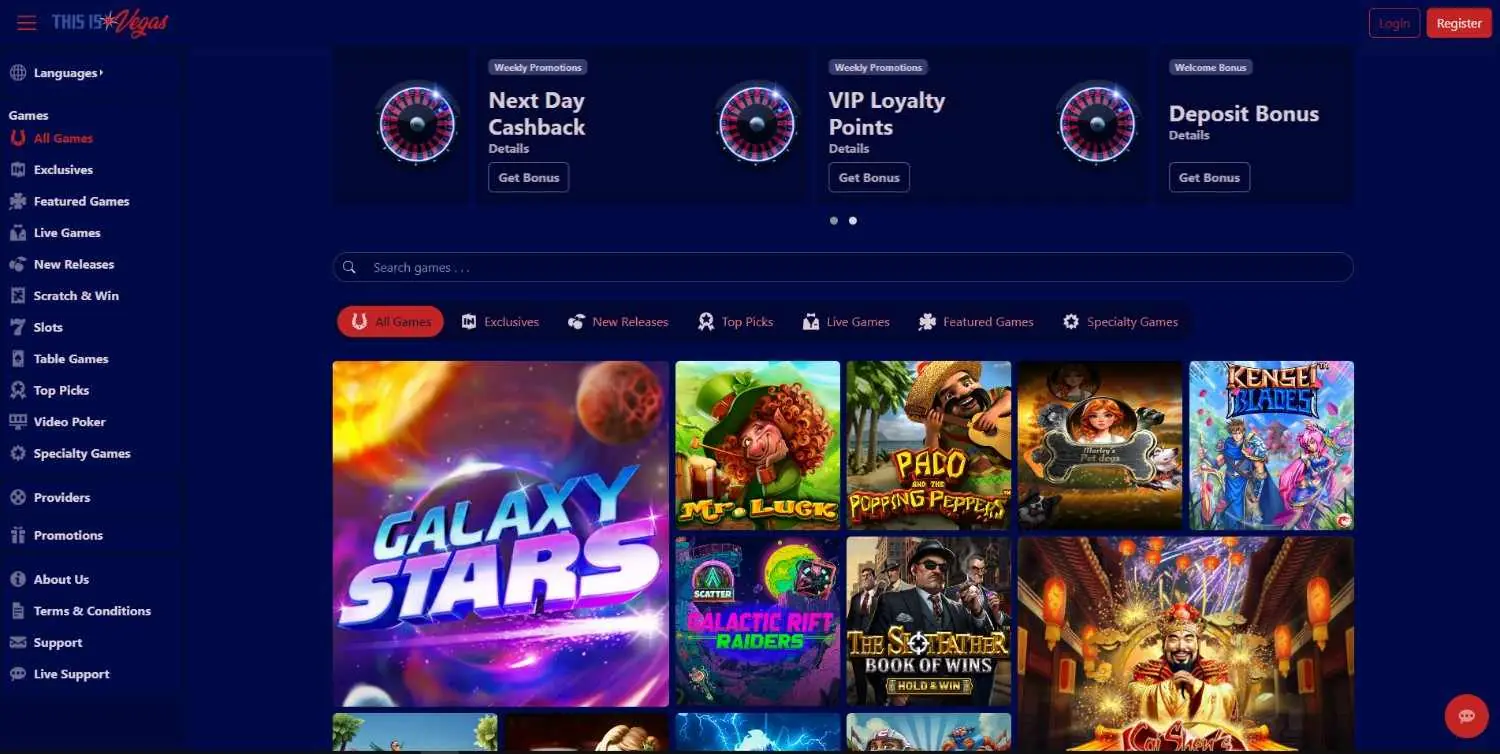
This Is Vegas is not a confirmed CandyLand Casino sister site in the same way NewVegas is, but it belongs in this guide because Rival-focused sister-site research repeatedly uses it as a comparable casino for players who like old-school Rival software. It is part of the wider legacy Rival/offshore comparison set, not a clean CandyLand operator sibling.
The theme is straightforward: Las Vegas branding, classic casino imagery, and a small but familiar Rival-style lobby. CandyLand is sweeter and more playful; This Is Vegas is more traditional and casino-themed. Both appeal to players who like smaller game libraries, frequent bonuses, and simple layouts rather than huge modern aggregator lobbies.
A Paradise 8 Casino review is another useful legacy Rival-style comparison for players weighing CandyLand against older offshore casinos.
The biggest positive is bonus familiarity. Sister-site research describes This Is Vegas with a 200% match bonus on the first Bitcoin deposit plus cashback-style value. That looks attractive next to CandyLand’s small free-chip and no-deposit-bonus reputation, but the real value depends on wagering, game exclusions, maximum cashout rules, and withdrawal speed.
The concern is that This Is Vegas sits in the same low-trust category as many legacy Rival-style casinos. In prior Cocoa Casino research, This Is Vegas carried a Very Low Casino Guru Safety Index and unfair T&C concerns. That makes it unsuitable as a safety-led upgrade. Its role is more specific: it is a familiar alternative for players who want a Vegas theme and Rival-style games.
This Is Vegas is best for players who like CandyLand’s software style but want a more traditional casino theme. It is not the best choice for players trying to escape slow withdrawals or old-school bonus traps.
| Metric | Details |
| Site Identity | Legacy Vegas-themed Rival-style casino |
| What Sets It Apart | Traditional casino theme and Bitcoin-match-style bonus positioning |
| Game Selection | Rival, Betsoft, Arrow’s Edge-style small-library casino content |
| Best Bonus Feature | 200% first Bitcoin deposit-style offer reported |
| Honest Drawback | Not a safety-led upgrade from CandyLand |
| Ideal Player | Players who want a Vegas-themed alternative with similar old-school feel |

DuckyLuck is the strongest CandyLand Casino alternative by independent safety score in this guide. It is not a CandyLand sister site, but it targets a similar player type: international casino users who enjoy bonuses, slots, free chips, and a lighter, playful casino identity. The important difference is that Casino Guru gives DuckyLuck a 7.9/10 Safety Index, far above CandyLand’s 3.7/10.
The design is more modern and more gamified than CandyLand. CandyLand uses a candy theme around a traditional Rival-style casino structure. DuckyLuck has a brighter, rewards-driven feel, with DuckyBucks-style loyalty and promotional mechanics commonly discussed in third-party casino analysis. That makes it a better fit for players who want recurring value without the same low-safety profile.
DuckyLuck is often discussed in the same ecosystem because it uses comparable software and targets a similar player base. Sister-site analysis positions it as a high-match-bonus alternative, with a larger promotional ceiling than many Cocoa-style casinos. Its DuckyBucks-style rewards and social-media-driven promotions make it more interactive than Cocoa Casino’s recurring free-chip style, while a LolaJack casino comparison sits closer to newer offshore account design.
The main reason to pick DuckyLuck is trust score. A 7.9/10 Casino Guru score does not make it perfect, and forum complaints still exist, but it is a materially stronger independent safety signal than the 3.7/10 scores shown by CandyLand Casino and several related-style alternatives.
Players comparing a playful brand tone may also find a Bella Casino review useful, although Bella belongs to a separate operator context.
DuckyLuck is the best external alternative if your main reason for leaving CandyLand is risk. It is not the best choice if you specifically want CandyLand’s exact Rival-style feel, but it is the most convincing safer-scored option in this article.
| Metric | Details |
| Site Identity | Playful international casino with stronger safety score |
| What Sets It Apart | Much higher Casino Guru Safety Index than CandyLand |
| Game Selection | Slots, live casino, and gamified rewards-style content |
| Best Bonus Feature | High match and free-spin packages vary by campaign |
| Honest Drawback | Still needs offshore bonus and withdrawal caution |
| Ideal Player | Players seeking a safer-scored alternative to CandyLand |
CandyLand Casino performs poorly against its closest confirmed sister site and most external alternatives. Its 3.7/10 Casino Guru Safety Index is slightly below NewVegas at 3.9/10, and far below DuckyLuck at 7.9/10. The only real advantage CandyLand has is its specific candy-themed identity and frequent free-chip reputation.
On bonuses, CandyLand looks attractive at first because user reviews mention frequent $5 and $10 no-deposit bonuses, and Trustpilot’s company page shows many positive reviews praising free cash and spins. The problem is difficulty of conversion. Casino Guru user feedback mentions 40x to 75x wagering and very slow cashouts, which makes the headline generosity less useful.
On payments, CandyLand and NewVegas are almost identical: both list 19 payment methods and €500/£500 weekly withdrawal limits. That means switching from CandyLand to NewVegas does not solve the practical payout ceiling.
Slots Capital and DuckyLuck are stronger alternatives if the priority is safer structure. Super Slots offers a bigger, more modern casino-first environment, while This Is Vegas gives players a familiar legacy Rival-style alternative. CandyLand is not the best in any objective category except brand theme and small-bonus familiarity.
The most important 2026 fact is that CandyLand remains low-scored rather than newly rehabilitated. Casino Guru’s review was last updated on 8 February 2026 and still shows a 3.7/10 Low Safety Index, no verified licence, unfair T&Cs, and €500/£500 weekly withdrawal limits.
The second development is review-volume contrast. Trustpilot shows candyland.casino at 4.6/5 from 1,539 reviews, while Casino Guru rates the casino much lower. That split means players should not rely on one public review platform alone. Trustpilot indicates many happy users; Casino Guru identifies structural risks around licence, terms, complaints, and withdrawal limits.
No major new CandyLand sister site was verified in this research pass. The network appears stable around a small related-casino footprint rather than a growing modern operator estate.
| Payment Method | Min Deposit | Max Deposit | Withdrawal Time | Fees |
| Visa / Mastercard / Amex | Site and country dependent | Account dependent | Slower than crypto; verification-dependent | Deposit and withdrawal fees flagged by Casino Guru |
| Skrill / Neteller | Site dependent | Account dependent | Can still be slow after KYC | Method terms apply |
| PaysafeCard / Flexepin / Cashlib | Voucher-dependent | Voucher/account dependent | Often deposit-focused | Provider terms apply |
| Bitcoin / Bitcoin Cash / Litecoin | Crypto equivalent | Coin/account dependent | Often positioned as faster | Network fees may apply |
| Ethereum / Tether / USD Coin / Tron | Coin/account dependent | Coin/account dependent | Verification-dependent | Blockchain fees apply |
Casino Guru lists 19 payment options for CandyLand, including Skrill, Neteller, PaysafeCard, Mastercard, Visa, American Express, Bitcoin, Flexepin, Cashlib, Bitcoin Cash, Ethereum, Tether, USD Coin, Tron, PayDo, CashtoCode, MiFinity, Litecoin, and SEPA. It also flags deposit and withdrawal fees as a negative.
The withdrawal limit is the real concern. CandyLand is capped at €500, $500, £500, AUD 500, or ZAR 5,000 per week. That means even a modest £2,000 balance could take four weeks to withdraw if every request is approved on time. User comments and Casino Guru forum posts also describe long waits after document verification.
| Site | Top 5 Providers | Approx. Game Count | Live Dealer Available |
| CandyLand | Rival, Betsoft-style providers, crypto-casino suppliers | 19 payment methods; exact game count not verified | Yes, live categories listed |
| NewVegas | Rival-style library, crypto-casino suppliers | Similar small-library structure | Yes |
| Slots Capital | Rival, table games, video poker, live dealer games | Broad Rival catalogue | Yes |
| Super Slots | Betsoft-style and broader casino providers | Larger casino-first lobby | Yes |
| This Is Vegas | Rival, Betsoft, Arrow’s Edge-style content | Small legacy Rival-style library | Yes |
| DuckyLuck | Rival-style slots, live casino, gamified rewards content | Broader modern international library | Yes |
CandyLand’s game library is not the main issue. Casino Guru lists live chat and several casino categories, while user comments mention demo mode for all games. The site appears to offer the core Rival-style package: slots, table games, video poker, and live content.
The limitation is provider depth. Compared with modern casinos that list dozens of software suppliers, CandyLand sits in an older, smaller Rival-style ecosystem. Players who want a nostalgic, simple casino may like that. Players who expect thousands of games, extensive live dealer studios, crash games, and multiple jackpot networks will find better range elsewhere.
CandyLand has live casino access, but it should not be treated as a live-dealer specialist. The better description is an old-school casino with some live and table-game coverage. NewVegas, This Is Vegas, and Slots Capital follow a similar structure: Rival-style slots first, then table games, video poker, and some live dealer access.
Mobile usability appears functional, but not app-led. Trustpilot praise mentions switching to CandyLand for free cash and spins, and Casino Guru’s discussion shows players actively using the site, but no strong native app ecosystem was verified. For mobile-first players, DuckyLuck or Super Slots may feel more modern.
Loyalty is mostly bonus-led rather than transparent. CandyLand appears to rely on small no-deposit chips, free spins, recurring coupons, and player-specific offers. What is missing is a clear public VIP ladder with exact points, tier thresholds, cashback rates, and reward values. That makes loyalty hard to compare across the network.
CandyLand Casino should be treated as high caution. Casino Guru says it does not hold any official gambling licence, has unfair T&Cs, and operates with a low weekly withdrawal limit. It also flags an unfair maximum-win rule based on total deposits, dormant-account balance confiscation, restricted-game bonus rules, low-risk-play restrictions, and possible winnings confiscation for some basic betting techniques.
| Site | Licence Body | Licence No. | Responsible Gambling Tools | RNG Testing |
| CandyLand | No licence verified by Casino Guru | None verified | Account tools not fully assessed here | Not independently verified here |
| NewVegas | No licence verified by Casino Guru | None verified | Account tools not fully assessed here | Not independently verified here |
| Slots Capital | Curaçao Gaming Control Board listed by AskGamblers | Not fully verified here | Responsible gambling tools listed by AskGamblers | Not independently verified here |
| Super Slots | Offshore operator family; exact licence not verified here | Not fully verified here | Account tools not fully assessed here | Not independently verified here |
| This Is Vegas | Legacy offshore Rival-style operator | Not fully verified here | Account tools not fully assessed here | Not independently verified here |
| DuckyLuck | External offshore operator | Not fully assessed here | Account tools and complaints exist in public data | Not fully verified here |
Casino Guru lists 2 direct CandyLand complaints, 4 related-casino complaints, and 1,197 total black points. It also says no relevant casino blacklists mention CandyLand, but that positive point does not outweigh the no-licence status, unfair T&Cs, and very low weekly withdrawal cap.
The practical safety advice is simple: verify early, keep deposits small, avoid complicated bonus play, and screenshot every offer. CandyLand is not a casino where players should build a large balance and only then discover withdrawal limits or KYC friction.
CandyLand’s reputation is sharply split. Trustpilot shows a very strong 4.6/5 from 1,539 reviews, with many players praising free cash, spins, and helpful service. Casino Guru is much harsher, giving CandyLand a 3.7/10 Low Safety Index and Mixed user feedback from 16 user reviews.
| Source | What Players Praise | What Players Criticise |
| Trustpilot, 1,539 reviews | Free cash, spins, helpful service, easy switching from other casinos | Trustpilot alone does not resolve licence or T&C concerns |
| Casino Guru, Safety Index 3.7/10 | No major blacklist finding, low complaint value relative to size | No licence, unfair T&Cs, 1,197 black points, €500/£500 weekly cap |
| Casino Guru discussion | Some resolved withdrawal complaints after KYC | Delayed verification, slow payouts, 5–14 business-day wait complaints |
| Casinomeister | No direct current CandyLand rogue label verified in this pass | No direct warning should be claimed without a specific current page |
Casino Guru’s complaint section is important because it shows both risk and resolution. One UK player had verification and withdrawal delayed after a mandatory £15 deposit, but the case was marked resolved after the player confirmed verification and withdrawal progress. Another player from Minnesota reported a delayed $150 withdrawal after KYC, and that case was also eventually resolved.
The fair conclusion is that CandyLand does pay some players, but its structure creates friction: low weekly limits, slow verification, unfair rules, and high-wagering bonus complaints. That is why the Casino Guru score matters more than Trustpilot alone.
CandyLand’s bonus identity is built around frequent small offers. Casino Guru currently shows no active deposit or no-deposit bonus in its profile, but user reviews mention $5 and $10 no-deposit bonuses, 40x wagering, and high-wagering ranges around 40x to 75x. That makes CandyLand appealing for bonus hunters but difficult for clean withdrawals.
A worked example shows the issue. If a player receives a $10 no-deposit bonus with 40x wagering, the turnover requirement is $400 before any withdrawal is possible. If the bonus has a small maximum cashout or restricted games, the real value is even lower. At 75x wagering, the same $10 bonus would require $750 in qualifying bets.
Compared with sister sites and alternatives, CandyLand is not the strongest. NewVegas has similar issues and similar withdrawal limits. Slots Capital is better established as a Rival casino. Super Slots is stronger for a bigger casino-first experience. This Is Vegas offers a more traditional Vegas theme. DuckyLuck is the best option for a stronger safety score.
No reliable current standing no-deposit bonus should be assumed. CandyLand bonuses appear to change often, so live account terms matter more than old coupon pages.
The biggest missing piece is licence clarity. Casino Guru says CandyLand does not hold any official gambling licence. That is a serious gap because players have no verified regulator to escalate to if something goes wrong.
The second gap is fair T&Cs. Casino Guru flags several rules as unfair, including a maximum-win rule based on deposits, dormant-account balance confiscation, low-risk-play restrictions, and bonus-related forfeiture rules.
The third gap is withdrawal flexibility. A £500 or €500 weekly cap is low enough to make larger wins slow to access. It also makes every KYC delay more frustrating.
The fourth gap is modern software depth. CandyLand suits Rival-style players, but the game library is not broad enough to compete with new casinos with larger provider rosters.
Finally, loyalty transparency is weak. CandyLand has recurring free chips and bonuses, but no clear public VIP table with tier thresholds, reward rates, or long-term cashback values was verified. This is where low-wagering casinos are often easier to assess than high-friction bonus sites.
NewVegas is the closest confirmed CandyLand Casino sister site. It is the most relevant network comparison, but it does not meaningfully solve the safety issue because it has no verified licence, unfair T&Cs, and the same €500/£500 weekly withdrawal limit.
Slots Capital is the best Rival-style alternative. It is more established, has clearer company and licensing data through AskGamblers, and carries a stronger Casino Guru score than CandyLand.
Super Slots is the best casino-first alternative for players who want a bigger modern slot lobby and stronger US-facing brand identity. It is not complaint-free, but it is less directly tied to CandyLand’s small related-site network.
This Is Vegas is the legacy alternative for players who want a traditional Vegas theme and Rival-style play. It is not a safety-led upgrade.
DuckyLuck is the best external alternative overall because its Casino Guru Safety Index is far stronger than CandyLand’s. That leads into the final verdict.
CandyLand Casino has appeal for a specific player type: someone who likes old-school Rival games, small no-deposit chips, frequent free spins, and a candy-themed casino lobby. Trustpilot also shows many satisfied reviewers, which should not be ignored.
The problem is the risk profile. Casino Guru lists no verified licence, unfair T&Cs, a Low 3.7/10 Safety Index, 1,197 black points, and £500/€500 weekly withdrawal limits. Those are serious structural drawbacks, even if some players report positive experiences.
The best within-network comparison is NewVegas, but it is not a clean upgrade. The best Rival-style alternative is Slots Capital, and the best overall external alternative is DuckyLuck because it has a much stronger Casino Guru score. Practical advice before depositing at CandyLand or any CandyLand Casino sister site: complete your KYC verification immediately after registration, keep deposits modest, avoid high-wagering bonus traps, and screenshot all live terms before claiming a promotion.

Dermot Heathcote
Senior Casino Analyst
Dermot covers UK-licensed online casinos for WagerPals, focusing on UKGC compliance, payment safety, and bonus terms. He spends most of his time reading licence registers, withdrawal terms, and player-complaint forums so readers don't have to.